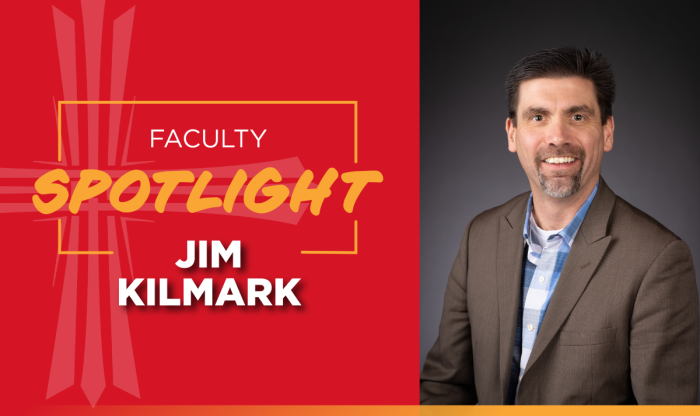
Michigan’s first physician assistant to serve as a PA program’s medical director, Jim Kilmark draws on his ER experience to prepare students for today’s evolving healthcare environment.
When Jim Kilmark joined Concordia University Ann Arbor in May 2026, he became the first PA in Michigan and possibly one of the first nationwide to serve as medical director of a Physician Assistant program.
Alongside his new role, Kilmark still sees patients in the emergency department at Trinity Health Ann Arbor. During a recent shift, he found himself asking a question that rarely comes up in a Michigan ER. What do you do about a jellyfish sting that’s still bothering a patient nearly two weeks later?
It’s a question a PA might hear more often in Florida than in the Midwest, right? The patient, who was six months pregnant, had been stung on the leg in Florida about 12 days earlier. She came to the ER because the irritation was getting worse.
“What PAs do I know in Florida that I can call right now?” Kilmark recalled thinking.
He looked up why the sting might still be bothering her and what options he could offer. Even after more than two decades in the ER, he still runs into cases that make him stop and say, “I’ve never seen that before.”
You can’t know what will come through the ER doors, but you can learn where to turn for answers when a case catches you off guard.
“I’m still learning things every day, every shift,” he said with smile.
A new role for PAs
National accreditation standards previously required a physician to serve as a PA program’s medical director. On Sept. 1, 2025, updated standards from the Accreditation Review Commission on Education for the Physician Assistant (ARC-PA) took effect, opening the role to qualified PAs.
A CUAA faculty member who also worked with Kilmark at Trinity Health told him about the opening and encouraged him to apply. He’d spent years teaching students on ER rotations and helping train PAs in emergency medicine.
“Honestly, what drew me to the position was the people within the program,” Kilmark said.
As part of his interview, Kilmark gave a short presentation on emergency medicine to a group of students. He remembers how quickly they took to the material.
“They were eating up the information,” he said. Seeing how eager the students were to learn gave Kilmark another reason to want to teach at CUAA.
What his job means for students
Still working full time in the emergency department, Kilmark draws on what he sees on shift to advise faculty on how to structure courses. That firsthand experience also helps him identify which skills students need before they start practicing and what they should learn on clinical rotations.
He also teaches emergency medicine in students’ final semester of classroom instruction. He wants them to know what to do when an unfamiliar case catches them off guard, like the jellyfish sting. Sometimes that means knowing who to ask. Sometimes it means looking up what the evidence says and figuring out how it applies to the patient in front of you.
“If you think you’re going to stop learning after you finish PA school, you’re going to have a rough go because there’s still a lot of medicine to learn,” Kilmark said.
And it helps to have someone show you what that looks like. While still in PA school, he met his longtime mentor on an emergency medicine rotation in Flint. Less than a year after graduation, he joined his mentor and the rest of the group that had taught him. The two went on to lead PAs at Trinity Health and develop training for their colleagues.
This new standard from the ARC-PA, Kilmark believes, will encourage more PA programs to seek out medical directors who take an active role in what students learn in the classroom and on clinical rotations.
Recognition from his peers
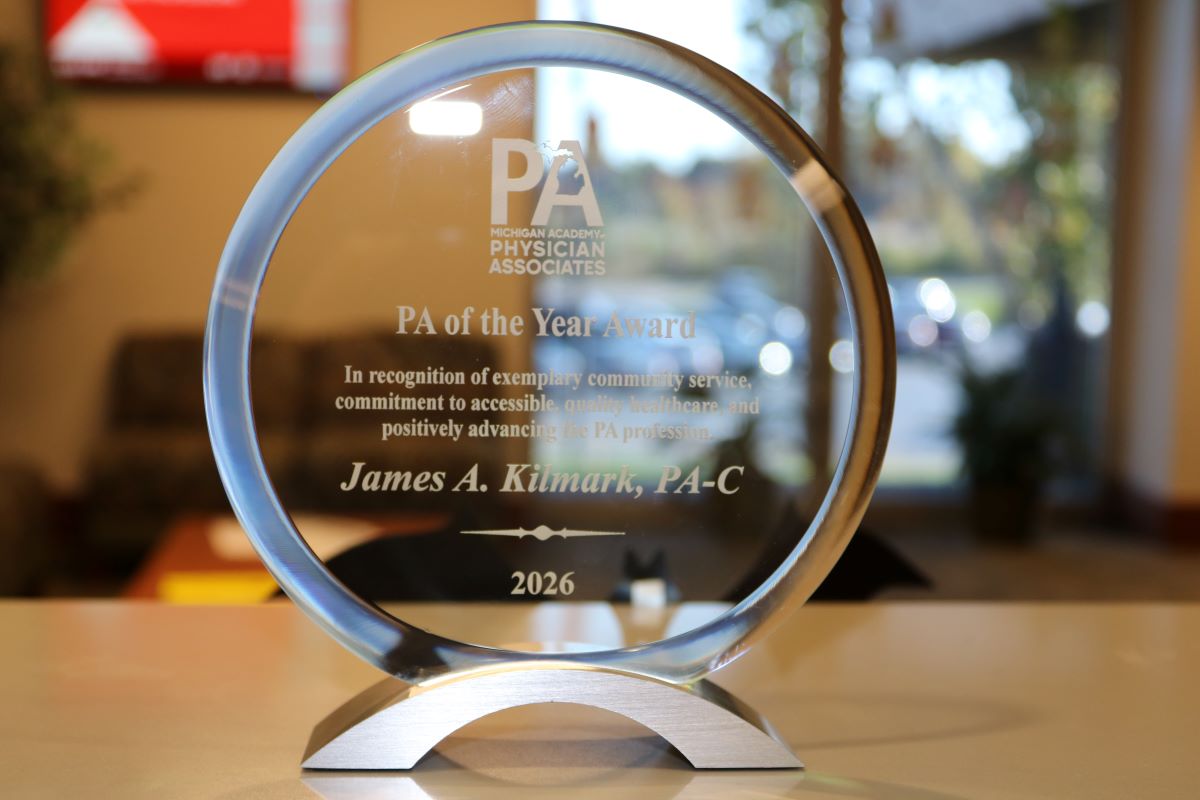
In October, the Michigan Academy of Physician Associates named Kilmark PA of the Year. He had volunteered with the academy for more than 20 years. The award recognizes community service, a commitment to accessible, quality care and contributions to the PA profession.
His wife, sister and in-laws made the trip. Dozens of CUAA students were there, too, to see their teacher accept the award just before the MAPA Quiz Bowl, an annual medical trivia competition for PA students.
“They were very enthusiastic,” Kilmark said. “It was very touching.”
When asked what he hopes students take from seeing a PA in this role, he talked about the work they’ll do long after their last rotation. There will always be something new to learn, but his advice about why you keep learning is pretty simple.
“Let’s take care of patients and do a good job doing it,” he said.
Want in?
Concordia University Ann Arbor is a Lutheran higher education community committed to helping students develop in mind, body and spirit for service to Christ in the Church and the world.
Click here to view a full list of the programs.