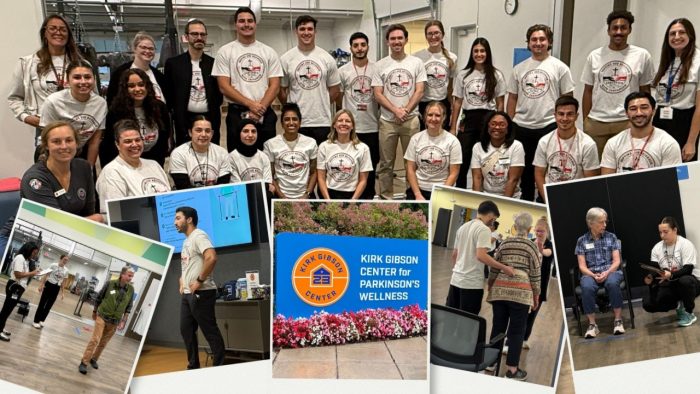
CUAA Doctor of Physical Therapy students put their education into practice through fall-prevention screenings, education and one-on-one support.
There was plenty of learning taking place at the No Falls Festival on Saturday, Sept. 19, but it wasn’t confined to a classroom.
Concordia University Ann Arbor Doctor of Physical Therapy students spent the day working directly with individuals living with Parkinson’s disease, offering fall-prevention education, home exercise guidance and individualized recommendations designed to help participants move more safely and confidently.
Held at the Kirk Gibson Center for Parkinson’s Wellness in Farmington Hills, the second annual event brought together CUAA students and faculty and the Michigan Parkinson Foundation to help people with Parkinson’s learn practical ways to prevent falls.
Putting education into practice
About 25 people with Parkinson’s and 20 caregivers took part in the festival. Twelve students from CUAA’s DPT Cohort of 2027 led assessments and fall-prevention education, with additional volunteers from the physical therapy faculty, other DPT cohorts and the pre-physical therapy program.
Second-year DPT student Will Kuchera worked with a woman with mild Parkinson’s symptoms who had always been active and athletic and had trained in ballet. Their conversation eventually turned to her experience caring for her parents. Her husband, who attended the festival with her, listened as they discussed ways he could support her.
“It was a really impactful moment that showed how our work as future physical therapists is not just isolated to our patients,” Kuchera said. “Our work touches the families, the caregivers and everyone else supporting the patient.”
Tarik Abdulreda had a different interaction that stayed with him. After Abdulreda walked a participant through exercises to continue at home, the man asked, “But what if I have a bad day?”
“It caught me off guard because I hadn’t thought about it from that angle,” Abdulreda said. “We ended up talking through how to scale the exercises down on tougher days instead of skipping them entirely, and I could tell that gave him a lot more confidence walking out than the handout alone would have.”
Abdulreda also noticed differences in how participants moved through two fall-risk screenings. The Timed Up and Go assesses mobility by timing a person as they stand from a chair, walk a short distance, turn and sit back down. The Mini-BESTest takes a closer look at balance through tasks such as turning while walking or stepping over obstacles.
Seeing participants respond differently to those screenings reinforced for Abdulreda that Parkinson’s disease can affect each person differently.
“Home exercises only work if the person believes they can do them on a hard day,” Abdulreda said. “Part of our job is building that confidence in, not just handing over a sheet.”
Melissa Kieffer, DPT, PhD, assistant professor of physical therapy and chair of admissions, saw that same attention to individual needs throughout the day.
“Our students truly embodied compassion for service—listening carefully, individualizing recommendations, and meeting each person with respect and encouragement,” Kieffer said.
The experience gave CUAA’s future physical therapists an opportunity to serve their neighbors while preparing for their calling in a profession centered on caring for others.
“Events like this remind us that clinical knowledge is most meaningful when it is shared in ways that empower others,” Kieffer said. “We are incredibly proud of our students and grateful to our community partners and participants for making this event such a success.”
Serving together with compassion
The festival also highlighted the partnership among CUAA, the Kirk Gibson Center for Parkinson’s Wellness and the Michigan Parkinson Foundation.
Mary Lynn Foster, CEO of the Kirk Gibson Center, said attendees appreciated the knowledge, encouragement and individualized attention they received from CUAA students.
“We are incredibly grateful to have hosted the students of Concordia University Ann Arbor in collaboration with the Michigan Parkinson Foundation for their meaningful service to our Parkinson’s community,” Foster said.
Jennifer Muscat, program outreach manager for the Michigan Parkinson Foundation, emphasized why that personalized support matters.
“For people living with Parkinson’s, changes in balance and mobility can make the risk of falls a very real and scary aspect of everyday life,” Muscat said. “At the No Falls Festival, Concordia University Ann Arbor students shared their knowledge, taking the time to listen, connect and make sure everyone left with personalized exercises and support strategies to implement into their daily lives.”
Muscat hopes the partnership will continue. “With the growing need for fall-prevention education, the Michigan Parkinson Foundation looks forward to working with CUAA to grow this event,” she said.
A follow-up event
The No Falls Festival may be over, but the work continues. Another event will be held Saturday, Oct. 17, at the Kirk Gibson Center for Parkinson’s Wellness, giving participants another opportunity to build on what they learned at the September festival.
Interested in helping? Those who would like to assist on Oct. 17 can contact Melissa Kieffer at Melissa.Kieffer@cuaa.edu for more information.
Want in?
Concordia University Ann Arbor is a Lutheran higher education community committed to helping students develop in mind, body and spirit for service to Christ in the Church and the world.
Click here to view a full list of the programs.