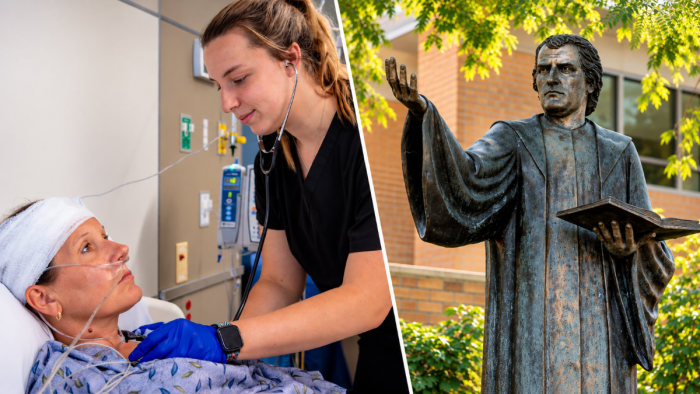
More than 500 years after Martin Luther helped spark the Protestant Reformation, his teachings on vocation continue to influence how Concordia University Ann Arbor prepares future healthcare professionals to serve others.
What does a 16th-century German monk have to do with a nurse caring for patients, a physical therapist helping someone regain mobility or a physician assistant diagnosing an illness? Quite a bit, actually.
When Martin Luther helped spark the Protestant Reformation in 1517, he challenged more than the religious practices of his time. His teachings also changed how Christians understood their responsibilities to God and the people around them.
One of those teachings centered on vocation, the understanding that Christians can serve God through their everyday responsibilities, not just through work within the church. A teacher educating children, a parent caring for a family member or a farmer tending a field could each serve their neighbors by putting their God-given gifts and abilities to work.
More than five centuries later, that same understanding applies to healthcare professionals caring for patients in hospitals, clinics and rehabilitation centers.
But there’s more to caring for someone than understanding what’s happening inside the human body. That’s a distinction Concordia hopes its future healthcare professionals will appreciate long before they enter the workforce.
What Luther understood about work
Each year on Oct. 31, Lutherans commemorate the Reformation, when Luther challenged certain teachings and practices within the church. Luther’s concerns were deeply personal. As an Augustinian monk, he wrestled with questions about sin, forgiveness and how he could find favor with God.
CUAA’s campus pastor Rev. Dr. Tony Sikora explored those questions in his 2025 Reformation Day reflection, A gracious God for a sinful monk.
Luther came to understand that salvation wasn’t something people could earn through good works or religious effort. It was a gift of God’s grace, received through faith in Jesus Christ.
That understanding became central to the Reformation. Concordia also examined these teachings in 501 Years Later: Solas Applied, which discusses the principles of Scripture alone, faith alone and grace alone.
So, what does that have to do with someone’s career?
According to Luther’s understanding of vocation, Christians don’t earn God’s favor by doing good things. Instead, their work and responsibilities provide opportunities to serve their neighbors in response to the grace they’ve already received.
Dr. John Boonenberg, Concordia’s Kreft Endowed Chair in Music and director of the Healthcare & Humanities Lab, approaches that teaching from two perspectives. As a church worker in The Lutheran Church—Missouri Synod, he’s familiar with the theological foundation of vocation. Through his work at CUAA, he also has an opportunity to consider how those teachings relate to students preparing to serve others.
“We don’t serve our neighbors in order to earn God’s love; we serve because God’s love has already been given to us,” Boonenberg said.
That distinction is especially meaningful in healthcare, where professionals can face tremendous pressure to fix problems, produce results and measure success by patient outcomes.
Those outcomes matter, Boonenberg explained, but healthcare professionals can’t control every result or relieve every form of suffering.
“Vocation reminds us that our responsibility is to faithfully serve the person entrusted to our care, even when the outcome is uncertain,” he said. “We serve not to prove our worth, but because our neighbor has worth.”
It’s a distinction that can change how someone thinks about a profession. A healthcare career may provide a paycheck, professional advancement and personal satisfaction. But Luther’s understanding of vocation asks Christians to consider something else: Who benefits from the work they’re doing?
That question is particularly relevant in healthcare, where professionals often care for patients who feel frightened, frustrated or overwhelmed by circumstances beyond their control.
What the humanities have to do with healthcare
Becoming a healthcare professional requires an extensive understanding of the human body. Students learn anatomy, physiology, medical terminology and clinical procedures. They practice evaluating symptoms, developing treatment plans and responding to situations that require quick decisions.
But there’s another side to patient care that doesn’t always fit neatly into a textbook.
A patient may be struggling with the loss of independence following an injury. Someone facing a serious diagnosis may have questions that go beyond the medical explanation. Another person may simply need reassurance that their concerns are being heard.
These experiences involve more than clinical knowledge. That’s where Boonenberg’s work with Concordia’s Healthcare & Humanities Lab enters the conversation.
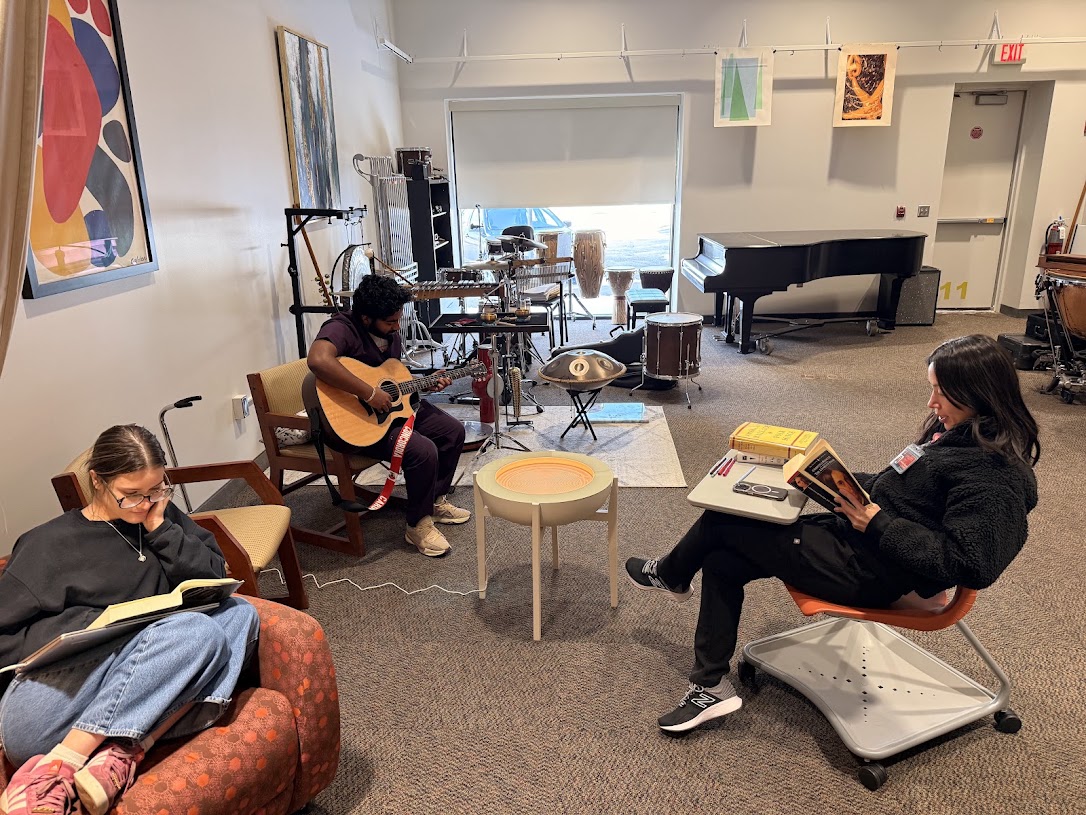
The lab creates opportunities for students to explore aspects of the human experience that can be difficult to capture in a clinical assessment. Through literature, poetry, visual art, music, creative writing and reflection, students consider how illness affects a person’s identity, relationships and sense of self.
“We want students to understand that a patient is never simply a condition to be treated or a problem to be solved,” Boonenberg said. “Each patient is a whole person with a history, relationships, hopes, fears and inherent dignity.”
One example is the lab’s interdisciplinary programming around cancer and rehabilitation. Working with Concordia’s occupational therapy and physical therapy programs, the lab has incorporated patient and caregiver art, poetry, music and other humanities-based activities to help students consider the emotional and social dimensions of cancer and recovery.
A patient may be making measurable physical progress while still struggling with isolation, anxiety about the future or frustration over activities they can no longer enjoy. A physical assessment may not fully capture those deeply personal experiences. However, they can significantly affect a person’s recovery and quality of life.
The humanities-based activities encourage students to consider questions that extend beyond a patient’s physical abilities. What matters to this person, what have they lost, and what gives their life meaning? How might healthcare professionals support their mind and soul alongside their body’s healing process?
Boonenberg said the humanities also help students practice listening carefully, observing before making assumptions and considering perspectives different from their own. Two people with the same diagnosis, after all, may experience illness in very different ways.
This emphasis on understanding and caring for the whole person also reflects Luther’s understanding of vocation.
A physician assistant may know which tests to order but still need to learn how to recognize when a patient feels overwhelmed. A physical therapist may understand the steps involved in rehabilitation but also need to appreciate how discouraging a slow recovery can be.
Neither situation makes clinical expertise less important. Instead, both demonstrate why healthcare professionals need to understand the people they’re treating.
Concordia has previously explored the relationship between work and service in the article, Job, career or vocation? Understanding the difference.
It’s an understanding that asks future healthcare professionals to consider not only what they’re trained to do but also how their work affects the people around them.
When the textbook isn’t enough
Students can spend hours studying medical conditions and practicing clinical procedures. But working with patients also requires them to respond to needs they may not anticipate. Those experiences can change how students understand their responsibilities.
Annaka Zaiser, a second-year occupational therapy doctoral student, is preparing to put that understanding into practice as she approaches Level II fieldwork and her doctoral capstone experience. She expects to graduate in May 2028.
Her interest in healthcare has grown alongside a calling to ministry. In addition to preparing to become an OT, Zaiser has completed the coursework and certification exam for her Director of Church Ministry Certificate through CUW. She is awaiting her final interview before becoming a rostered church worker in the LCMS.
“From a young age, I felt called into service for Christ,” Zaiser said. Her own health challenges helped her recognize the ways healthcare professionals serve God by caring for others. At CUAA, she sees that understanding reflected in how students prepare for practice.
“In the OTD program at CUAA, there is a prominent emphasis on Christ-like service of others,” she said. “We take our textbook learning and apply it hands-on during in-class simulations.”
Those simulations ask students to consider more than whether they have addressed a diagnosis. Zaiser said they also learn to consider whether a client feels safe, comfortable, cared for and acknowledged. Mental health, spirituality and individual goals are part of that understanding of care.
“People were never meant to be reduced to a diagnosis, and learning at CUAA has helped me understand how serving people as Christ called me to and God equipped me for ensures holistic, comprehensive healthcare!” she said.
It’s one thing to learn about compassion in a classroom. It’s another to practice it when a patient is upset, progress is slow or the right words are difficult to find. Those moments can be just as important to a student’s professional development as learning to perform a new procedure.
And while Luther couldn’t have imagined the technology or medical treatments available today, his understanding of vocation still raises a question worth asking: How can the work we do benefit the people who depend on us?
Zaiser sees that question connecting both of the paths she is preparing to pursue. “Whether I end up in church work or in the medical field as an OT, I know I will be serving God as He has prepared me through my time at CUAA,” she said.
An uncommon life in an ordinary profession
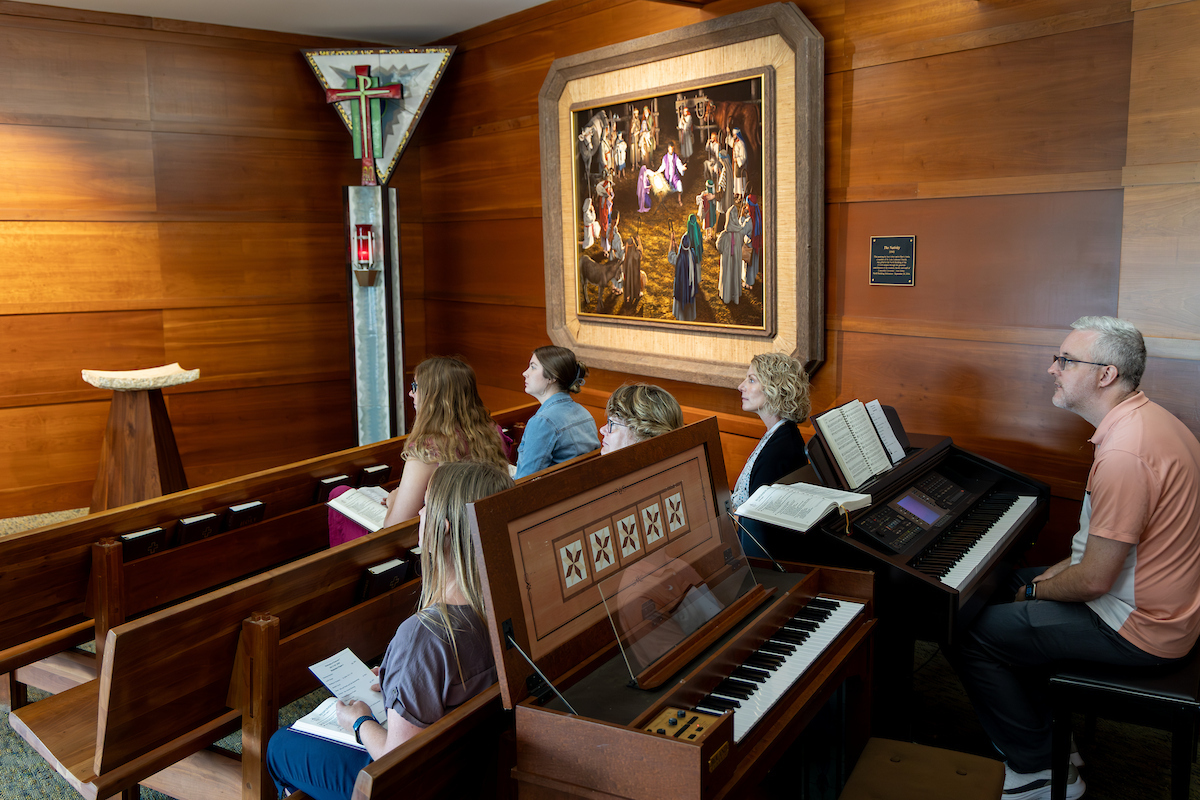
Concordia’s mission is to help students develop in mind, body and spirit in service to Christ in the Church and the world. That mission extends beyond the classroom and into the professions students eventually enter.
A healthcare career won’t always be easy. Some days will involve difficult conversations, long hours and outcomes that don’t go as planned. But opportunities to serve others aren’t limited to moments when everything goes right.
They may come when a patient needs someone to explain a diagnosis again, when a person recovering from an injury becomes discouraged or when a healthcare professional recognizes that listening is just as important as knowing what to say.
Boonenberg believes Luther’s understanding of vocation remains relevant because, despite centuries of medical advances, the fundamental human need to be cared for hasn’t changed.
“Faith and professional excellence are not competing priorities,” he said. “We want students to pursue excellence precisely because the people they serve matter.”
Luther’s teachings remind Christians that serving God isn’t limited to a particular occupation or setting. Sometimes, it means doing the work we’ve been given with an understanding of how our actions affect others.
At Concordia, future healthcare professionals are preparing to do just that.
Want in?
Concordia University Ann Arbor is a Lutheran higher education community committed to helping students develop in mind, body and spirit for service to Christ in the Church and the world.
Click here to view a full list of the programs.